About
Between the courtroom and academic research on AI and robotics.
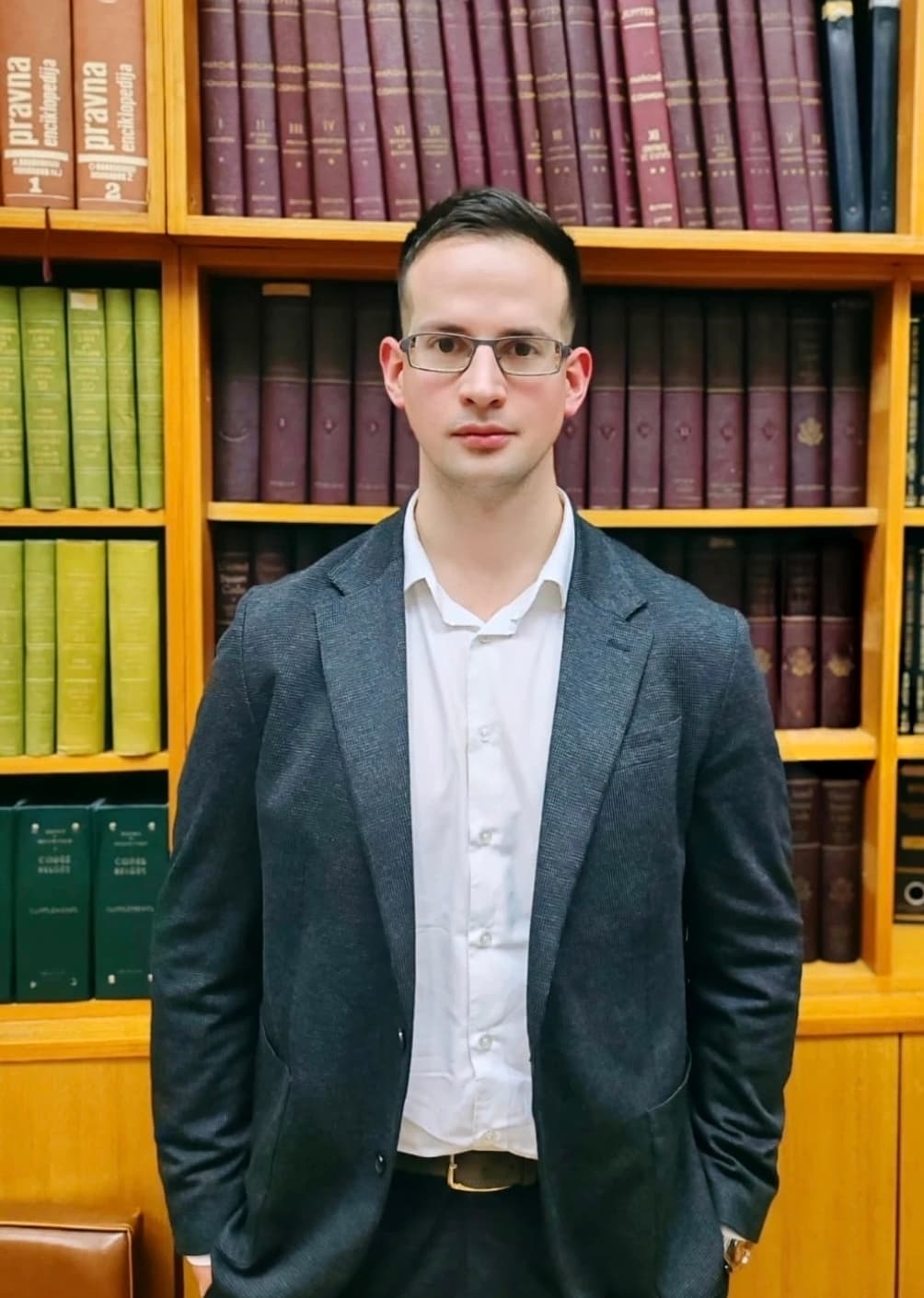
Janko Munjić is a Senior Judicial Assistant in the Criminal Department of the Appellate Court in Kragujevac and a PhD Candidate in Criminal Law at the University of Kragujevac Faculty of Law.
His work focuses on criminal responsibility, artificial intelligence, robotics, digital evidence and the transformation of justice. It connects judicial practice with academic research on responsibility gaps, AI-mediated decision-making and standards for technologically complex evidence in criminal proceedings.
He has presented his research at international conferences across Europe and received the Best Paper Award at WeRobot 2026 in Berlin for his paper on hybrid intention and a test for posthuman agents.
His position in the criminal judiciary gives the research a practical grounding. Artificial intelligence, robotics and digital evidence reach the courts as questions of legal categories, procedure and proof, and his work approaches them on those terms.
Why this profile is unusual
Three things rarely found together: judicial practice, doctoral criminal-law research, and international work on AI and robotics.
Judiciary
Senior Judicial Assistant, Criminal Department, Appellate Court in Kragujevac
Doctoral Research
PhD Candidate in Criminal Law, University of Kragujevac Faculty of Law
Recognition
Best Paper Award, WeRobot 2026
Focus
AI, robotics, digital evidence and the future of criminal responsibility
Selected credentials
Peer-review work for Kutafin Law Review, Frontiers in Robotics and AI, and other journals indexed in major academic databases, including Scopus and Web of Science.
Scholarship participant in the AI Winter School “Introduction to AI in Law and Business” at the Faculty of Law and Administration, University of Warsaw (January 2026).
Forthcoming chapter with Cambridge Scholars Publishing, developed from work presented in Grenoble on AI-enabled judicial cooperation, fundamental rights and European legal standards.
Accepted chapter for Supernatural Law: Regulating the Paranormal, on telepathic technologies, hybrid intention and criminal responsibility for symbiotic human-technology agents.
Research identity
Grounded in how courts actually reason.
His work inside the criminal judiciary gives the research a practical institutional grounding. It engages the theoretical questions raised by intelligent systems from the standpoint of someone who works with criminal procedure and appellate reasoning.
International profile
A defining legal question for the coming years.
How legal systems should attribute responsibility, assess evidence and protect human rights in AI-mediated proceedings is among the central questions criminal law now faces. It is the focus of his international work.